Camila Vintage: A Timeless Serif Font for Handmade Brands
If you’ve ever spent hours tweaking a candle label only to find the typeface feels too stiff—or too fussy—then Camila Vintage is the serif font that quietly solves both problems. It’s not just another retro-inspired typeface; it’s a carefully balanced blend of mid-century warmth and modern clarity, designed with physical product makers in mind. As someone who hand-prints greeting cards, cuts vinyl for boutique tags, and designs printable wedding suites, I reach for Camila Vintage when I need elegance that *works*: readable at 8pt on a tea towel tag, expressive at 120pt on a farmhouse welcome board, and consistently charming across every format—from SVG files cut on my Cricut to high-res PDFs sold as digital downloads.
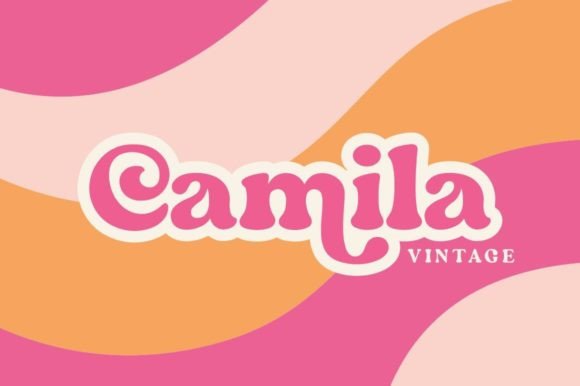
Camila Vintage is a modern and elegant retro serif—think refined 1950s typography softened with subtle curves and open letterforms. Its lowercase a, g, and e carry gentle personality without sacrificing legibility. Uppercase letters have quiet presence—not shouty, not shy—and spacing is thoughtfully tuned for both tight labels and generous wall art layouts. Unlike some vintage serifs that lean heavily into ornamentation, Camila Vintage keeps its charm grounded, making it ideal for small-batch sellers who want sophistication without sacrificing function.
This font shines where handmade products meet customer expectations: on product packaging that sits beside competitors on Etsy or local shop shelves, on invitation suites that must feel personal yet polished, and on printable planner pages where readability matters after five cups of coffee. I’ve used Camila Vintage for lavender-scented soap labels (paired with a clean sans serif for ingredients), rustic wedding welcome signs (with swash capitals for “Welcome” and standard weight for names and times), and holiday-themed mug designs—where its gentle contrast and even rhythm prevent visual fatigue, even in bold black-on-white prints.
For crafters using cutting machines, Camila Vintage performs reliably. Its letterforms avoid ultra-thin hairlines or fragile terminals that can break during vinyl weeding or fine-detail engraving. At sizes as small as 6–8pt, key characters like R, B, and Q retain shape and distinction—critical for tiny jar labels or gift tag ribbons. When scaled up for large-format prints (like 24"x36" wall art or storefront signage), the font’s OpenType features become invaluable: access to stylistic alternates lets me swap in a more decorative g or y for emphasis, while ligatures smooth out common pairings like “fi” and “fl” in longer phrases such as “Farmhouse Favorites” or “Hand-Poured With Love.”
Camila Vintage works beautifully as a display font—but it also holds up surprisingly well for short blocks of body text. I use it for headline + subhead combinations in printable quote art (“Gather Well. Live Fully.”), for boutique clothing tags (brand name in Camila Vintage, care instructions in a neutral sans), and for seasonal product bundles (e.g., “Spring Collection” headers paired with bullet-pointed features in a lighter weight). It’s not meant for novels or long-form web copy—but for the concise, intentional wording that defines handmade goods? It’s exceptionally capable.
Font pairing is where Camila Vintage reveals its versatility. Try it with a relaxed handwritten font for greeting card sentiments—its structure gives the script room to breathe. Pair it with a geometric sans serif (like Montserrat or Poppins) for packaging that balances heritage and clarity: Camila Vintage for the brand name, the sans for net weight, ingredients, or QR codes. For wedding stationery, layer it with a delicate script for names and a sturdy slab serif for RSVP details. The key is contrast without competition—let Camila Vintage anchor the design while supporting fonts add texture or utility.
You’ll get multiple weights and styles (regular, italic, bold, bold italic), plus full OpenType support—including discretionary ligatures, contextual alternates, and multilingual characters covering Western and Central European languages. That means your French bakery labels, German-language printable planners, or bilingual baby shower invites stay typographically cohesive and professionally rendered. Files come in OTF and TTF formats, compatible with Silhouette Studio, Cricut Design Space, Adobe Creative Cloud, Canva Pro, and most major design platforms.
One practical note many creators overlook: commercial licensing. Camila Vintage is a premium font built for real business use. Its license covers physical product creation (stickers, mugs, tote bags, apparel), digital downloads (PDF printables, PNG overlays, SVG cut files), template sales (Canva templates, editable Google Slides), and client work (logo design, branding kits, social media graphics). No need to track impressions or purchase extended licenses for basic small-business use—just design, produce, and sell with confidence.
Whether you’re printing botanical tea labels in muted sage and cream, designing minimalist baby milestone cards, or crafting gold-foiled wedding menus, Camila Vintage brings a sense of considered craftsmanship to every project. It doesn’t scream for attention—it invites closer looking. And in a marketplace where customers choose handmade goods for their authenticity and care, that quiet confidence is exactly what makes your brand feel trustworthy, memorable, and unmistakably yours.